
“There are many publications that are highly endangered, and the red list is a reminder to pick out the hundreds or thousands of millions and deal with these red list nominees,” commented Mari Siiner, Chair of the Council for the Preservation of Cultural Heritage on 20th February 2004.
The aim of the project, which started in 2001, was to compile a list of priority, endangered and rare books for the preservation of national memory, digitise the selected publications, make them available and mark them in an e-catalogue and the DIGAR portal. As rare books of high value for Estonian history, science and cultural history are located in various Estonian memory institutions – libraries, archives and museums – several institutions across Estonia were involved in the project. It was also taken into account that a significant part of the rare books are in private hands and, due to historical events, also outside Estonia.
The project was carried out in two parts
Stage I (2001–2006) involved work on books from the years 1535–1850 (the original list contained 413 books). The working group consisted of Krista Aru, Estonian Literary Museum; Kurmo Konsa, University of Tartu; Tiiu Reimo, Tallinn University / Academic Library of Tallinn University; and Mari Siiner, National Library of Estonia (coordinator). The aforementioned institutions, along with the Tallinn City Archives, the Estonian Historical Archives, the Läänemaa Museum, the Conservation Centre Kanut, and Vallo Raun, contributed to the completion of the work. The project was made possible through targeted funding from UNESCO and the Estonian Ministry of Culture.
Stage II involved work with books from the years 1851–1917 (the original list included 1,526 books). The project to compile the list involved the Archival Library of the Estonian Literary Museum, the National Library of Estonia, the Academic Library of Tallinn University, and the University of Tartu Library. The project was managed by the Consortium of Estonian Libraries Network (ELNET).
Ensuring the preservation and accessibility of the Estonian Printed Heritage Red List and manuscript source texts of Estonian culture
In 2010–2012, a total of 240,000 pages of publications and archival materials significant to Estonian culture from the archives of the Literary Museum were digitised with the support of the European Regional Development Fund project “Ensuring the preservation and accessibility of the Estonian Printed Heritage Red List and manuscript source texts of Estonian culture.” Funding was provided through the Ministry of Economic Affairs and Communications, with the Information System Authority (RIA) acting as the implementing agency. The digitisation was carried out by the National Library of Estonia, the files were archived and made available in DIGAR.
The most representative part of the manuscripts from the Estonian Folklore Archives and the Estonian Cultural History Archives was digitised during the project. The manuscripts were conserved by OÜ Mandragora and digitised by the University of Tartu Library. The digitised material is available in the Estonian Literary Museum’s information system KIVIKE.
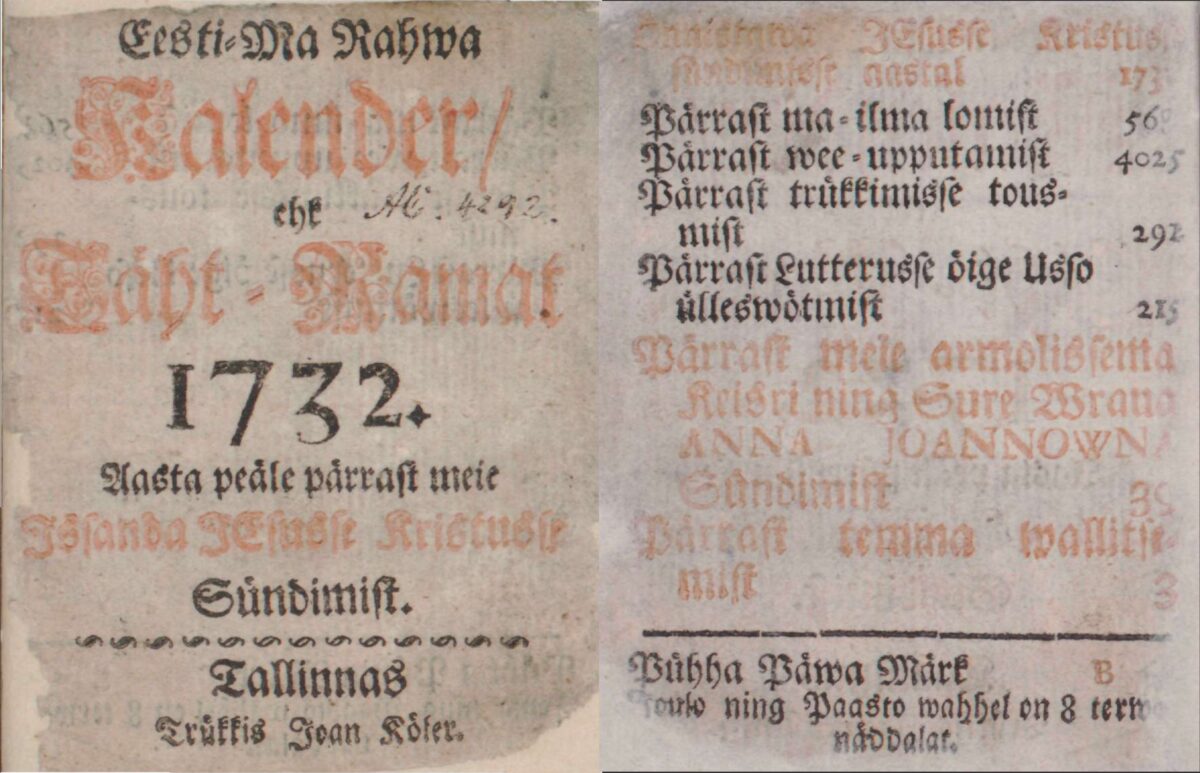
The oldest surviving Estonian calendar, of great circulation, use and significance for the rural way of life. It is an original copy and the only known Estonian-language edition from 1731.
Concepts
- Rare books or rarities are publications and manuscripts in Estonian published before 1861 and in foreign languages published before 1831, which have historical and cultural value.
- Old books are (Estonian) books published until 1944.
- Holding is a determination of the existence of a book and its location (library).
- Printed matter is a product made by means of a printing technique, e.g. a book, journal, newspaper, map, sheet music, etc.
Workflow
The list of the “Estonian Printed Heritage Red List” was compiled in close cooperation with the memory institutions, taking into account the cultural value of publications, their holding and condition. The publications were selected on the basis of specific criteria, and the conservation risks of the publications were carefully assessed on the basis of their condition. The selection was based on the publications of the Estonian retrospective national bibliography:
The cultural and historical value was assessed on the basis of:
- a book with an Estonian text,
- the first book fully in Estonian,
- the first publication in Estonia (in Tallinn, Tartu, Narva, Pärnu and elsewhere),
- the first publication of its own type (catechism, alphabet, calendar, newspaper, etc.),
- the first publication in a specific subject area (language, literature, history, geography, mathematics, etc.), the “Golden Book” aspect was followed,
- a publication that had a major impact on cultural trends in Estonia (publications relating to language, literature, education, science, religion, knowledge and practical skills),
- important publications in terms of the development of book design and printing techniques (the work of Estonian illustrators or, for example, the first illustrated publication),
- the most requested publications in our libraries.
The rarity was assessed on the basis of:
- unique copies,
- publications preserved in up to two Estonian libraries (plus private collections, museums, abroad),
- translated literature, translations of fiction, which are found in only one Estonian library,
- texts in danger of being lost – mimeograph reproductions (mostly plays), regardless of holding,
- all important series of the period 1851-1917 in their entirety (editorials of the Estonian Society of Writers, etc.),
- reprints preserved in only one Estonian library,
- publications without holding in Estonia, but are found outside of Estonia.
One and the same publication could belong to the group of rare books as well as to the group of cultural-historical selections. The fields (original literature, women’s rights, book trade, etc.) were distributed among the libraries participating in the project. From the selection of printed matter, statutes and reports, sheet music (only a few were taken), maps (some first editions were selected), plans, calendars, novels published as newspaper supplements, temporally close reprints, works by unknown authors (if no important information about the author, translator or design was added), 4-page ephemera, flyers were excluded.
Digitisation
The second phase consisted mainly of compiling an list of printed matter to be digitised, and assessing their suitability for digitisation on the basis of their integrity and condition. As a result, a total of 1975 titles were selected for digitisation. A guide to making digital back-up copies of the Estonian Printed Heritage Red List and old books was drawn up, as the red list contained a large number of damaged publications. Libraries digitised the nominations for the Estonian Printed Heritage Red List according to their own possibilities, and there was close cooperation between them. The digitised files were archived and made available on the DIGAR portal and in the e-catalogue.
View in the e-catalogue
The e-catalogue also contains information on the holdings and the number of copies of publications included in the “Estonian Printed Heritage Red List” in Estonian and foreign libraries and archives.
Partners